The Department of Education, cut funding on Sept. 10. for the “Puedes grant” which served students, staff, and faculty at Cal State Bakersfield, ending the $3 million, five-year grant funding pathway developed for Hispanic Serving Institutions.
The grant was discontinued 20 days before the renewal date; in turn CSUB was expecting two more years of funding. This grant had three goals that enhanced CSUB student life through Academic Programs, Institutional Management, and Fiscal Stability.
Regarding this situation, we met with CSUB’s Assistant Professor of Religious Studies, Dr. Joseph Florez, who was asked to take over this grant by a previous member of CSUB.
Due to Dr. Florez’ prior position he had within the HSI fellowship, he was able to give more insight on the impact this will have on our university community. He prepared reports about how the university served its Latinx students as well as making suggestions around the successes that CSUB has had, including areas for improvement going forward.
“There is currently a lawsuit, making its way through the court, which calls Hispanic Serving Institution designation as a form of racial discrimination. The federal government has decided that they agree with that lawsuit and has said that these funding streams are unconstitutional,” said Florez.
Under this grant many programs were provided for the community of CSUB, including Summer Bridge. In which 70 to 100 transfer students were provided knowledge and services before starting their courses. In addition, CSUB worked with about 250 first-year students with high-touch practices; this includes communication with student success coaches, approaching general problems students encounter, as well as helping with retention for previous students that had to leave CSUB prior to finishing.
———————————————————————-
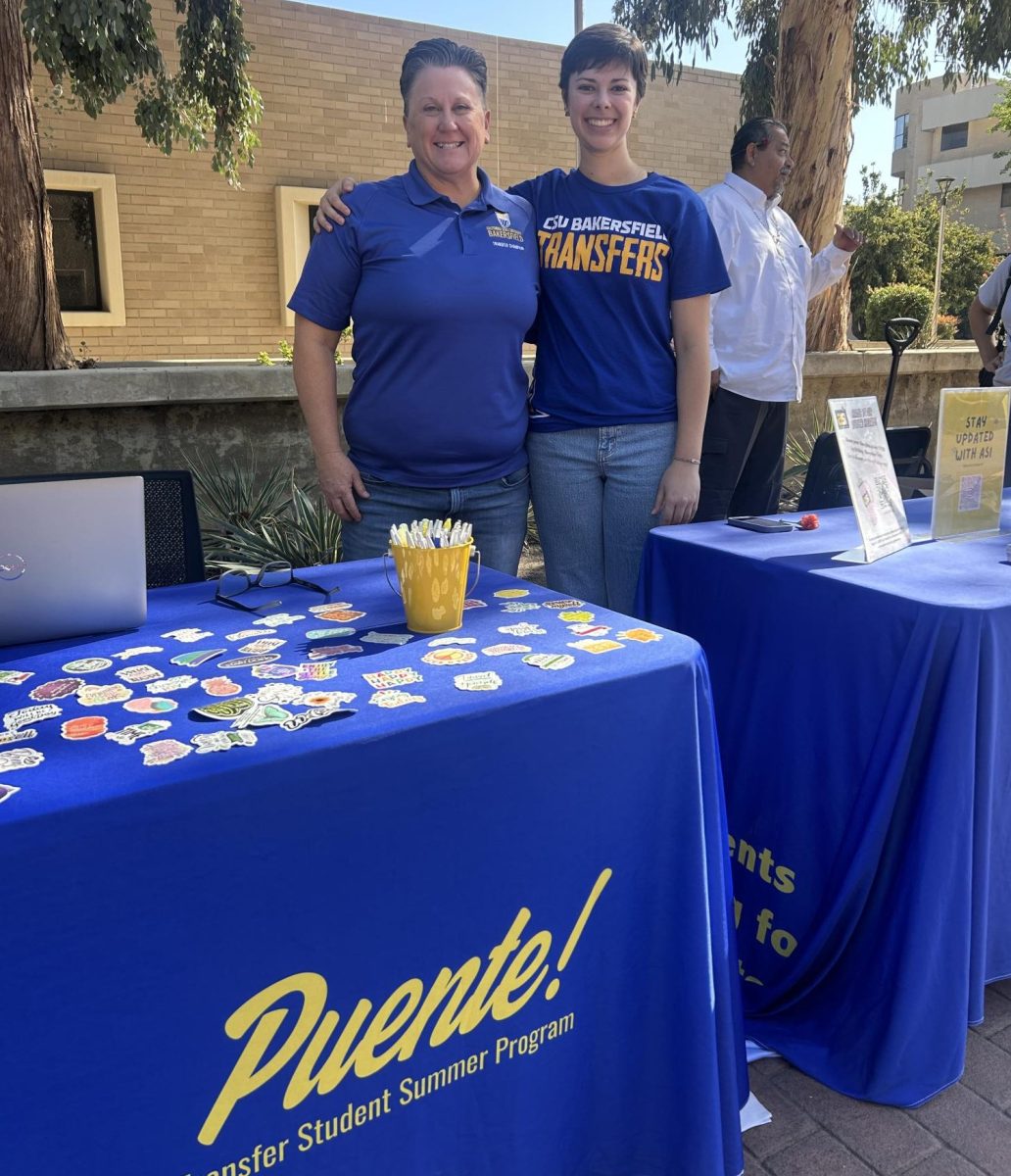
Darci Ross-Smith, an English major in her senior year, holds the title of the Director of Transfer Students for ASI and a Writing Consultant in the Writing Center. She experienced the Summer Bridge program which she describes to have had an English class that offered an opportunity to take the GWAR test at the end of the program, giving the students the possibility to pass their gen ed class over the summer before their year started at CSUB. As well as an orientation where people from CECE and the Student Health Center would come, they were given campus tours and advising; even including lunch with the Deans and Chairs. This deepened her knowledge towards a lot of the resources on campus.
Ross-Smith also worked for the program last summer, this summer, and helped run the program in August.
Ross-Smith speaks on her favorite part in working for the program- ” really just seeing how comfortable it made people. We have a large non-traditional student population in the transfer student demographic so bringing them into the Summer Bridge program and then seeing how they blossomed and felt so much more confident and knew exactly where they needed to go to rent laptops, get IT help, get writing help, get tutoring help, who to talk to”
“It’s super cool to see the ‘can do’ attitude that comes out of that like ‘yeah, I am making the right choice coming back to school and I’m going to do really good at it’” said Ross-Smith
Addressing the discontinuation, Ross-Smith states, “I’m very sad to see it go. I think that it was very useful for the students who chose to sign up for it. It’s done a lot of good for the students who are in” it’s really hard for transfer students to stay in school. The retention rates for transfer students are amazing and the graduation rates are often 3 years instead of 2 once they come to CSUB and I think that this program helps you settle in so much quicker that you’re able to better succeed in school so it is really unfortunate to see it go and I wish we could have seen it grow more and effect even more of the student population.”
Considering the lawsuit, it was decided federally that Title V A was deemed as racial segregation.
Ross-Smith states, “I think that we were not facing the issues that were discussed in the lawsuits where there was discrimination happening. I think that a lot of people when they hear about the Puente program they assume that it’s for the Hispanic population, only and exclusively, i am a white student and i was in it and i know there were other white kids in the program who were able to benefit just as well. I think CSUB does a good job in prioritizing their Hispanic population while not excluding other populations and so I’m sad that we weren’t even facing the issues that caused that grant to go”
Ross-Smith speaks about the program being discontinued does not mean that they aren’t still here for help and how “there are ways for students to still get the support they need even though this was cut so suddenly.”
The advice and direction Ross-Smith would like to make known considering the sudden changes, “I think ASI is great because it has its fingers in so many different areas so regardless of what your issue is, you can bring it to ASI and then they can direct you to the right people. There’s also the dreamers resource center, MAGIC, the counseling center, your academic advisors, faculty advisors. When people are new and not really sure what’s happening, I think ASI is a solid first option.” The ASI office is in the student union and you can also leave a comment, question, or concern through https://www.csub.edu/asi/about-us/index.shtml
Ross-Smith also notes another impact this will have on the CSUB community.
“I think there’s also a big concern with the employees that are affected by this grant being cut. So many employees have been let go. I was let go from my spot in the program. Kris the other day was saying ‘I’m taking on the job of three people now cause we just don’t have the funds’ and that’s a big community impact with so many people losing their jobs.” “not only are there educational resources being cut but there are also jobs that students relied on”
————————————————————
Kris Grappendorf, Faculty Director of Academic Systems, carried a position in the grant K16 pathways coordinator. Grappendorf is “sad, concerned, and worried about the direction that the department of education is taking at the federal level in terms of making decisions like this to suspend Title V grants that have helped institutions like ours, HSI institutions.”
Grappendorf works on transfer pathways; this includes how they can get students from the community college to the university in terms of what that pathway looks like. They partner with all community colleges to clearly identify courses that students need to take to transfer to a university. She gives an example of what this looks like, “If you want to be a communications major, here’s what you take at Taft and here’s what you take at CSUB”.
These pathways streamline the process through transferring to a university to make the transition smooth. Dual enrollment programs were also funded through this Title V grant to help expand this type of pathway. These are college level classes that become available for high school students to take during their junior and/or senior years to get ahead in earning college credits.
Considering the impact this has on faculty members, the funds from this grant were used to pay professors or other faculty members for their time to help work on these pathways as well as expanding the program. Since the funds were cut, faculty members will return to their normal content of work. Grappendorf explains the process of “buying out faculty time” as “awarding them a course release. If you do XYZ Project for us, we will pay somebody else to teach your course.” This type of process and inclusion allows for professors and faculty members to extend their help with student college needs; in this case transfer students, first-generationals, and underrepresented students. Furthermore, Grappendorf states, “So losing that model results in full time faculty having to teach those classes and then you can see the trickle-down effect that that had when we didn’t hire part-time faculty.”
This in itself affects the students. Grappendorf continues, “because you have to have people to do the work. If you want faculty to spend additional time supporting students, you have to give them time and that’s where the grant money comes in handy. For us to provide financial resources to qualified, quality individuals to spend extra time for students.”
Understanding that CSUB is an institution within 100 miles from numerous community colleges. This impact inhibiting pathways for transfer students affects a lot of people as well as the long- term vision towards the future workforce. “Kern County is an area that is growing faster in terms of population and jobs, and were not producing enough bachelor’s degrees to meet the workforce demands”
“If we can’t support students to get into those degrees because funding’s been caught, the end outcome is we don’t have enough people to meet the demands of the workforce. Education has to keep up with the growth” – said Grappendorf
Going further into the long-term effect of Title V grants being suspended, Grappendorf states, “We’re talking millions of dollars and that’s hard to recover. I mean what do you do? Especially at a time when the economy is bad. Campus has had to cut back anyway. This just adds to that. How are we going to operate, how are we going to continue some of these programs?”
In addition, this grant also provided services between 60 to 80 faculty members every year in professional development; this includes knowledge towards helping them better understand things such as basic needs so that they could better serve their students. They were also running question persuade response training for suicide prevention programs. To deepen your understanding towards the other programs and services provided under this grant, you can find more information through CSUB’s website www.csub.edu/puedes/.
Dr. Florez said, and I quote, that there has, “certainly been a lot of disappointment and I think a lot of people at CSUB and the CSU system, more generally, are still trying to assess the impact of this loss of funding on our students and on our communities.”
In regard to this, Dr. Florez says that, “the funding that was coming to us as an HSI was being used for all students”. He also stated that these programs “were open, regardless of any identity characteristics” and “the point of this funding stream, a Title V A grant, was to develop Hispanic-Serving Institutions and to improve us as a community.”
We can now understand that CSUB being an HSI, impacts all students plus the faculty and staff. This is an on-going case considering all other grants for CSUB that have been targeted for cancellation, discontinuation, or non-renewal.