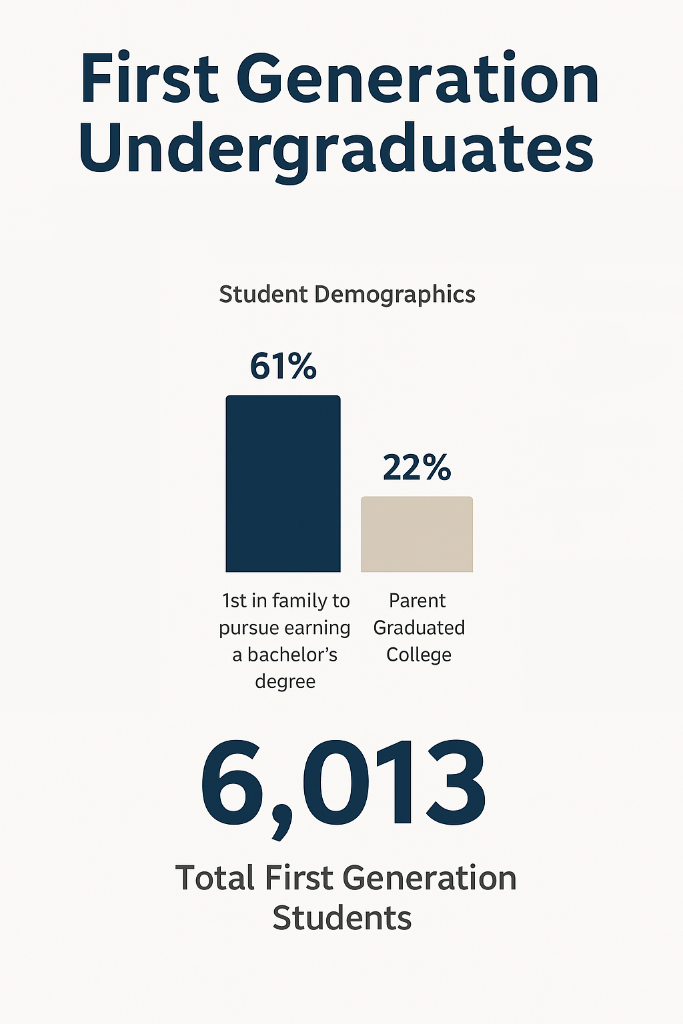
Cal State Bakersfield is home to a large population of first-generation college students. According to CSUB’s Fall 2025 student enrollment census data, 61% of undergraduates identify as first-gen.
Navigating college is not always a straightforward path; for many, it comes with struggles and pressures, especially for those who are first-generation. Mentorship and guidance play a big role in helping students get to graduation.
Emily Poole Callahan, the Dean of Students, recognizes the importance of mentorship and offering students the resources they need to succeed.
As a little girl, Callahan saw her mother walk the stage as she graduated from CSUB. Her mother was a first-generation college student, working full-time with kids. Her mother’s graduation was a catalyst in her life. Seeing her mom work hard for years and how difficult it was for her made her realize the importance of having campus resources to help students.
Of CSUB’s undergraduate students, 40% transfer from a California community college, many coming from Bakersfield College. Viridiana Santa Cruz, a first-generation political science major, transferred to CSUB after attending Bakersfield College.
“I don’t have anyone here that I can say that helped navigate university life or the resources” said Santa Cruz.
Santa Cruz describes her college experience as a journey filled with obstacles and marked by perseverance. She mentioned that the transition from BC to CSUB was difficult and intimidating.
During her time at BC she felt more supported, at CSUB she didn’t feel a sense of belonging. She was intimidated by the university being more independent and harder to navigate. Some of her professors were discouraging and didn’t offer support.
While at CSUB, Santa Cruz has had to juggle having a full time job and trying to afford tuition, while also being a full time student worrying about her immigration status.
Her family migrated from Guerrero, Mexico where 6th grade was the highest education there was. Santa Cruz felt obligated to pursue higher education because of all the sacrifices her family made. Her family couldn’t offer her much guidance since neither of her parents went to college.
After graduation, Santa Cruz has a career lined up with the County and is studying to pass the Law School Admissions Test (LSAT).
Of CSUB’s undergraduate students, 53% come here from a public high school. Jazmin Rodriguez entered CSUB as a freshman after graduating from high school. Her first years of college were marked with uncertainty.
Like many first- generation students, she struggled on deciding what to major in, ultimately deciding on double majoring in criminal justice and biochemistry with a minor in psychology, with the goal of applying to forensic programs. She plans to stay in-state and work at a crime lab.
While part of her college experience was clouded with uncertainty, Rodriguez describes being a first generation college student as a rewarding experience.
She recalls not having a mentor until her third year. That guidance helped her reevaluate her educational goals and take on a second major.
“As a freshman and first gen it was difficult without mentorship and guidance,” said Rodriguez. “I advise incoming freshmen or any student to find someone if they can to help guide them in any way.”
Her college experience reshaped her identity. She now mentors incoming biochemistry students, helping them find support in the area she once lacked.
Callahan shared that CSUB has resources and programs geared towards first-generation students such as the Education Opportunity Program, Project Rebound, Guardian Scholars, Counseling, Mental Health Counseling and CARE services which support students facing academic, financial or personal crises.
“I think it’s important that we continue to promote the programs that we do have, but also identify what, what more we can do,” said Callahan.
Callahan recognizes that not every student has someone at home to guide them but she is hopeful to help bridge the gap for those first generation students to one day be able to help future generations.
“Through all the barriers and challenges, they are advancing themselves to do something that will help future generations,” said Callahan.