Cal State Bakersfield held a town hall on April 24, to discuss the instructional budget model that determines how academic departments are funded and staffed. Faculty, staff, and students gathered for the presentation where university officials Provost Deborah Thein, VP Kristen Watson, Senate Chair Melissa Danforth discussed the model in detail. The purpose was to present how the model aligns resources with student demand. Attendees, though, did raise questions about the potential impacts on instruction.
Dr. Kent Henderson, associate professor of sociology at CSUB, said when asked about any potential concerns regarding the model, “I’d like to see faculty and students have a say. I think the academic Senate would be a good vehicle to institutionalize or formalize that input.” Dr. Henderson continued, “I definitely feel more confident now after this meeting. I very much felt like I was in the dark. We just kind of had a budget model all of a sudden and didn’t really know where it was coming from.”
Overall, the instructional budget model helps determine how funding for faculty positions is distributed across colleges based on student enrollment and teaching demand. The model uses formulas to determine these allocations.
Full-Time Equivalent Students, measures enrollment while Student-Faculty Ration is a target for class size and workload. Also included are Weighted Teaching Units which is the amount of instruction required for each college, and Full-Time Equivalent Faculty, the number of instructors required, both tenured or tenured-track faculty and lecturers, both full-time and part-time.
In other words, the higher the enrollment, the more teaching units are required, which determines the number of instructors and how much funding each department receives.
For example, university officials presented scenarios that showed how resources might be distributed across colleges.
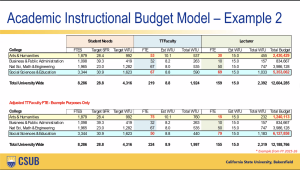
One scenario showed that adjusting the number of FTEs to reflect higher tenure/tenure-track faculty would significantly reduce the need for full and part-time lecturers, allowing for more retention of the total budget.
The proposed model has the potential to affect class sizes and course availability, the balance between tenure-track professors and lecturers, and faculty workload as well as hiring priorities. Some attendees expressed concern about how these changes could impact the quality of education and long-term stability of academic programs. Tiffany Tsantsoulas, assistant professor of philosophy and chair of the Academic Affairs Committee was asked her biggest takeaway from the discussion. She stated, “We have a long way to go to ensure that our instructional budget model is values driven, because the way the model works, we could see driving toward less robust program and course offerings.”
During the town hall, the attendees asked about how target ratios like SFRs are determined, whether departments can appeal or adjust allocations and the potential reliance on reserves.
University representatives responded by emphasizing that the model is a collaborative effort between colleges and associate deans and is still in development, and feedback from the campus community will help shape future model adjustments. They also noted that the goal is to create a more transparent and data-driven budgeting process.
As the university continues to refine the model, many attendees said they are waiting to see how it will impact their departments and the day-to-day academic experience.