What if the scariest concept in a horror movie wasn’t its supernatural elements, but the hushed savagery of its protagonist?
Directed by brothers Yossy and Jack Zagha Kababie, “The Containment,” released in 2026, considers this concept far too late, relying on tried-and-true formulas rather than true creativity to frame its story.
The film begins between a mother and her son. She aims a shotgun at him as he rambles nonsensically. His eyes are eerily blackened. Images of Egyptian hieroglyphics and scarab beetles frame his computer. Suddenly, he lunges at his mother; she fires. Clutching her son, the mother laments her profound loss. In her misery, a scarab beetle emerges from her son’s body and flutters out the window, searching for a new host.
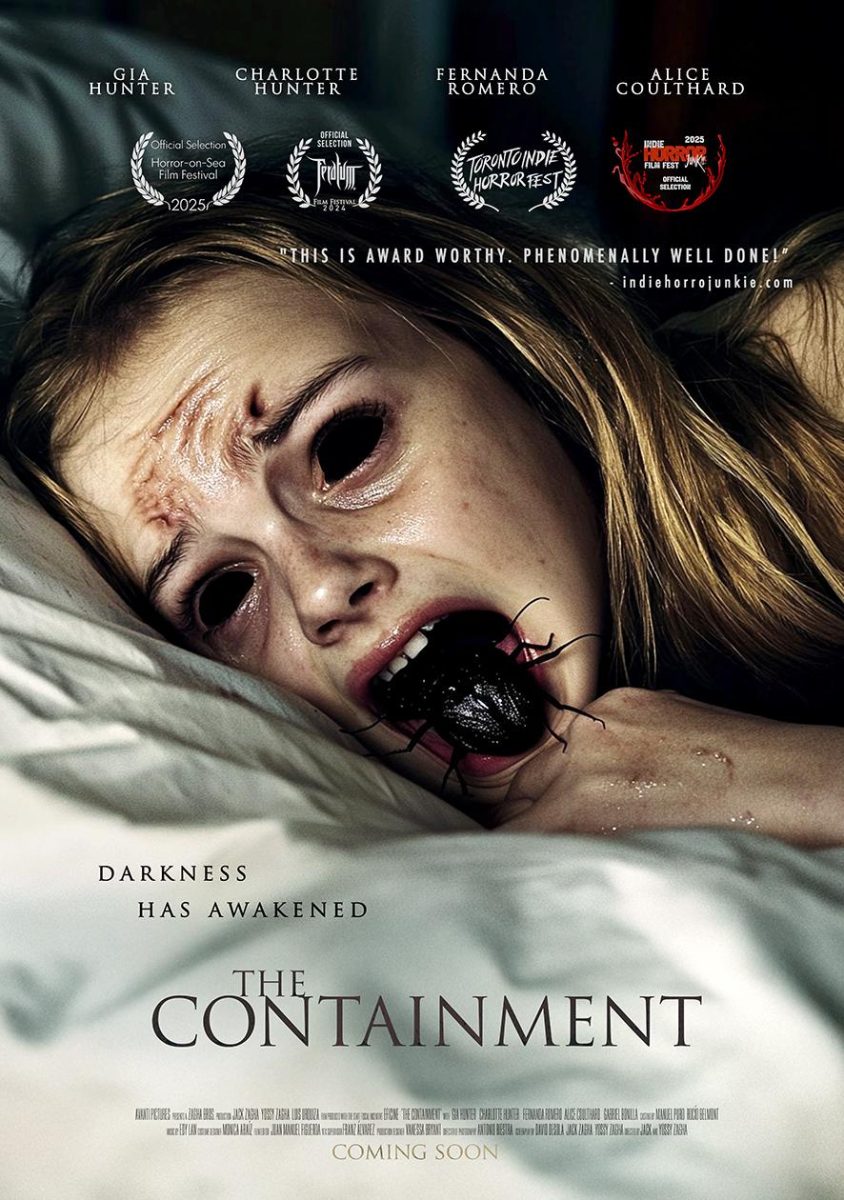
14-year-old Caroline Cobbler (as portrayed by Gia Hunter) is a troubled girl grieving the sudden death of her father. Her mother’s a mess, and her brother, Dom, won’t speak. One night, the scarab beetle creeps into her bedroom and down her throat. The cycle of possession continues–however, it’s different this time. Rather than remaining stationary, the scarab beetle crawls underneath her skin, manifesting as a tattoo to unsuspecting friends and family.
In ancient Egypt, scarab beetles signified transformation and were used for amulets of protection. According to Kanaya Mehta’s article, “Ancient Egyptian Tools and Beliefs,” these amulets were “inscribed with spells, incantations, and the names of deities… thought to imbue the wearer with magical powers to ward off evil spirits and ensure a successful transition to the afterlife.” In contrast to the beetle’s historical symbolism, the demon actually seems to be protecting Caroline from herself rather than any external force, with it fending off the depravity from within her. As one of the film’s more compelling elements, I wish it had been further developed rather than being relegated to the wings; it’s the very essence of “The Containment,” and there should’ve been adequate room for this idea to thrive.
The audience watches as Caroline’s true nature unravels near the film’s end. She pushes Sister Esperanza, a nun who was trying to save her, from a water tower and toward her death. The juxtaposition of Esperanza and his father’s death inspires Dom to reveal that Caroline murdered their disabled father. These “revelations” felt undeserved as they came completely out of nowhere; there was no satisfying build-up, which made this disclosure of information lackluster and impulsive.
Additionally, scenes of Caroline’s limp body levitating and contorting in mid-air, followed by shots of her black eyes and peculiar demon voice, were comical to witness. “The Containment” special effects were incredibly disappointing; Caroline’s blackened eyes appear to be edited in post-production, which feels stale and lifeless. Furthermore, I found myself laughing during certain scenes where the demon was speaking through Caroline. The demon’s nasally and somewhat high-pitched voice took me out of the story at times, leaving me to question the absurdity of what I was watching.
Besides the movie’s technical aspects, the usage of the classic demon trope causes the film to lose its seriousness and identity. For example, there’s a scene where Caroline draws a pentagram and plans to sacrifice a bunny to demonstrate her submission to the demon possessing her. Cliché moments like this feed into the audience’s expectations about the occult and demon worship, leading horror enthusiasts to sigh because it’s familiar and overdone.
Unsurprisingly, Catholicism is used as an aesthetic background rather than adequately engaged with. From crucifixes to the confessionals, the church’s visual nature has become synonymous with demon horror. Films including Catholicism primarily follow a familiar blueprint of good versus evil, or faith versus secular. Most of these films end in goodness prevailing, but “The Containment” went another route, giving evil the win. Although I enjoyed the twist, Catholicism’s inclusion in this film felt unnecessary and pointless as a driving force within the plot. Highlighting Ancient Egyptian religious practices instead of relying on Christianity would’ve added an unconventional yet fresh perspective on demon horror.
“The Containment” was an uninspired and, at times, derivative interpretation of previous supernatural horror films. I was expecting to be terrified – paranoid to the point of insomnia – but I instead left the theater disappointed for wasting my time.
So, the next time I watch a horror film where demons are at the forefront, I expect something more powerful and thought-provoking. I hope for a movie that focuses on the horror of humanity’s wickedness instead of using familiarity as a crutch. Dear directors: I beg you to make your interesting ideas known fast. Otherwise, I may use your film as naptime.