In a nuclear submarine off the coast of California, sailor David Melendez hooked the crew’s dog on a leash before walking it around the engine room–a routine that he had established in his sunless 16-hour workdays. He and his crew members had not seen the world beyond the submarine in weeks and thus relied on their dog to keep them entertained. However, the loudly barking dog that they played with and cared for was not real, but a construct of their collective imagination.
U.S. Navy veteran and Cal State Bakersfield professor David Melendez discovered his passion for theatre during his service in the navy and now teaches his students the art that taught him how to not only reconnect with his humanity but to survive.
“When I tell students in theater it’s life or death, it very much is,” said Melendez. “Performance has the ability to validate a human existence.”
Melendez lectured upon performance capturing and easing the aspects of the human condition within his Restoration to Experimentation class. Even noting that theatre portrays the human experience not only through elaborate plot points, but rather slices of mundane life, or as he teaches, the “tranche de vie.”
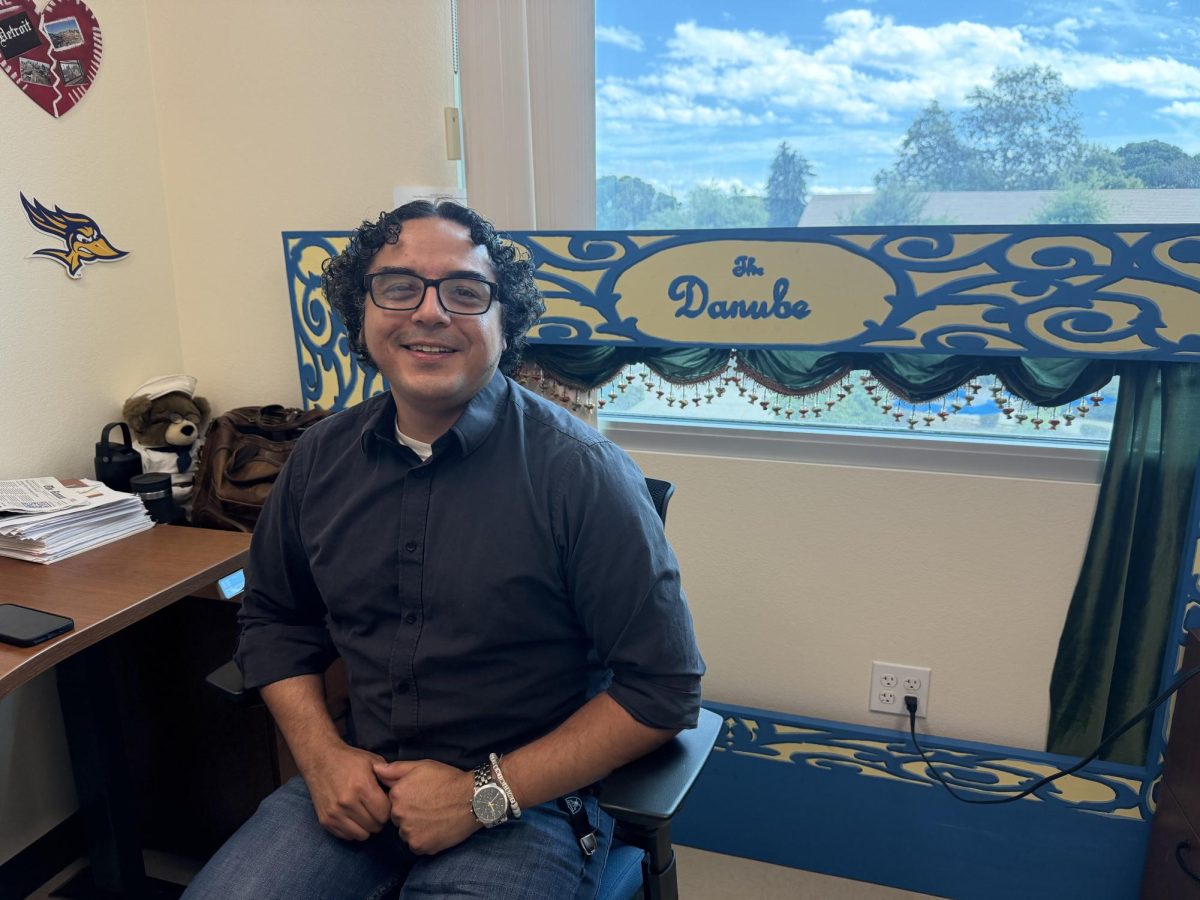
Melendez recounted his slices of life, as he sat perfectly framed within a miniature stage frame of “Danube,” a play that he directed at CSUB, which is about living life fully amidst the looming threat of death.
Stephanie Toro, who starred in “Danube” is just one of Melendez’s many students who have heard the infamous “dog” story, which he makes a point to tell all of his classes. Toro equates the story to making the best out of any situation, a lesson that Melendez has had to learn throughout his life.
Melendez grew up in Rosamond, a small city on the outskirts of Kern County and near the Los Angeles County line, which he described as “a place that wasn’t really there.”
After graduating from Rosamond High School, he decided to go to college. However, he faced difficulties that many first-generation students are all too accustomed with.
“I didn’t know how to do FAFSA. …I was real timid,” said Melendez. “I didn’t know how to get the help I needed. …I felt so scared and so stupid not knowing what to do, that I just stopped going.”
Melendez attributed dropping out of college to growing up with an “inferiority complex.” He felt that he did not merit attention, which allowed him to not see things through.
However, that changed soon after when Melendez joined the United States Navy, where he completed the Navy Nuclear Power Program and literally learned to “fight” for himself.
He worked on a fast–attack submarine as an Engineering Laboratory Technician, which seconded as a journey of self-education, where in his downtime, he would sneak off to read books like: “Wuthering Heights,” “Of War and Peace,” and “Ana Karenina.”
Melendez said that the harshness of life on the submarine would make people mentally “snap” around the third week at sea. In a hushed voice and with avoidant eyes, he revealed that there were several suicide-attempts aboard his submarine.
To cope with life, Melendez and his crewmates wrote songs and put on performances, which is where he unknowingly discovered his passion for theatre.
“I didn’t know it was performance at the time,” said Melendez.
After his Navy service concluded, Melendez decided to go back to college, where he attended San Diego Mesa College. He then transferred to UCLA and then finally to the University of Minnesota, where he earned a doctorate in theatre.
Melendez was inspired to become a professor to continue learning, yet not only with other professors at national conferences but with the students in his classes.
Upon graduation, Melendez returned to Kern County, where he teaches Theatre History and Dramatic Literature. Besides teaching, he helps to make first-generation students and transfer students, like himself, feel welcome.
“He takes time to talk with all of his students, even if it’s to ask about how they are or to get their input; he always makes time for everyone,” said Toro.
She was quick to point out that Melendez is at every theatre club meeting.
Despite his devotion to students, Melendez will be the first to admit that transitioning back to civilian life has caused him to struggle socially, with him appearing awkward at times. However, it has become one of his distinguishing quirks, and a part of his charm that allows him to be himself.
Melendez is an entertainer. He teaches like he is on stage amidst a performance, where the students serve as audience members in his academic production, even becoming a part of the act.
In his act, Melendez proves that there is power in performance, strength through imagination and beauty in living life amidst the unknown while always striving to make the best out of the “tranche de vie.”