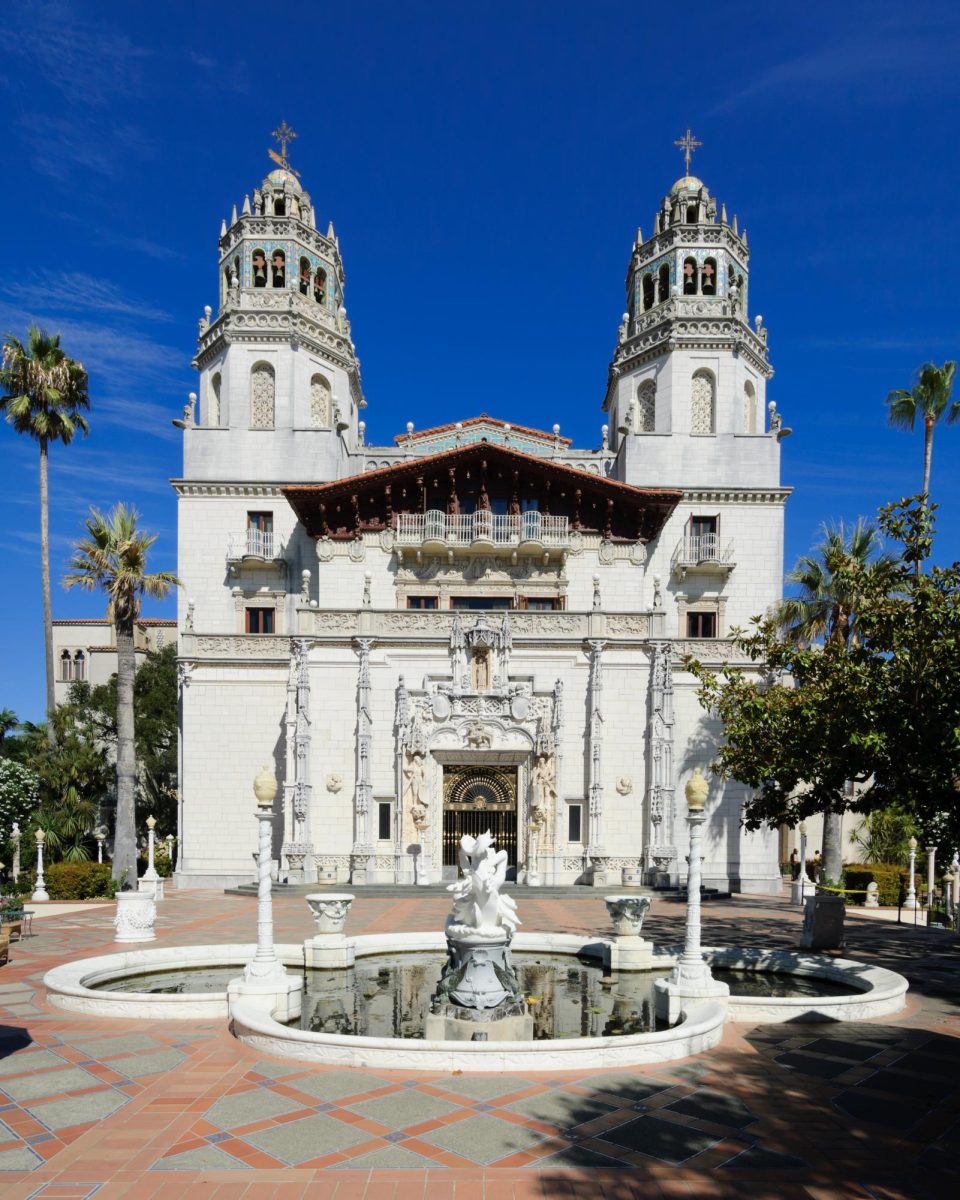
Hearst Castle, formally known as La Cuesta Encantada, Spanish for “The Enchanted Hill” located in San Simeon on the Central Coast of California. Envisioned by William Randolph Hearst, a newspaper and media tycoon, owner of one of the nation’s greatest newspaper chains and pioneer of sensationalized reporting. Together with his architect Julia Morgan they constructed the castle between 1919 to 1947. Today, Hearst Castle is a museum, open to the public as a national historic landmark, and serves to allow the people of today the chance to glimpse into the opulent life of its past occupants.
At this time, in 1865, Hearst’s father George Hearst purchased the original 40,000 acres used for family camping vacations. After the death of his mother Phoebe Hearst, Hearst would commission Julia Morgan, an architectural pioneer to “build something a little more comfortable up on the hill.”
Following this, Morgan would work closely with Hearst for 20 years as the castle was constructed. The castle was intended to be a family home for Hearst, shortly after starting Hearst surmised that making the castle a living museum where he fills it with the best things he could secure.
Subsequently, it was full of architectural elements from Western Europe, especially Spain. The luxurious estate hosted over thirty ceilings, doorcases, fireplaces and mantels, entire monasteries, paneling and a medieval tithe shipped directly to the castle. In addition, he built up collections of more conventional art and antiques of the highest quality he could acquire. He filled the buildings and grounds with thousands of works of art furnishing the sumptuous halls.
Ultimately, in 1947, Hearst’s health compelled him and his mistress to leave the castle for the final time. In 1951, Morgan passed away, and in the following year the Hearst family gave the castle and many of its contents to the State of California and the castle was opened to the public in June 1958. Since its opening it has served as a historical monument and hosts over 750,000 visitors a year serving as a gateway into the past.